

Tarot Symbolism: The Hierophant
He has been usually called the Pope, which is a particular application of the more general office that he symbolizes. He is the ruling power of external religion, as the High Priestess is the prevailing genius of the esoteric, withdrawn power.
—Arthur Edward Waite, The Pictorial Key to the Tarot
Arthur Waite explains in The Pictorial Key to the Tarot that the Hierophant has 'been called pope,' but that being a pope is only one possible earthly role for this figure. He goes on to say the Hierophant:
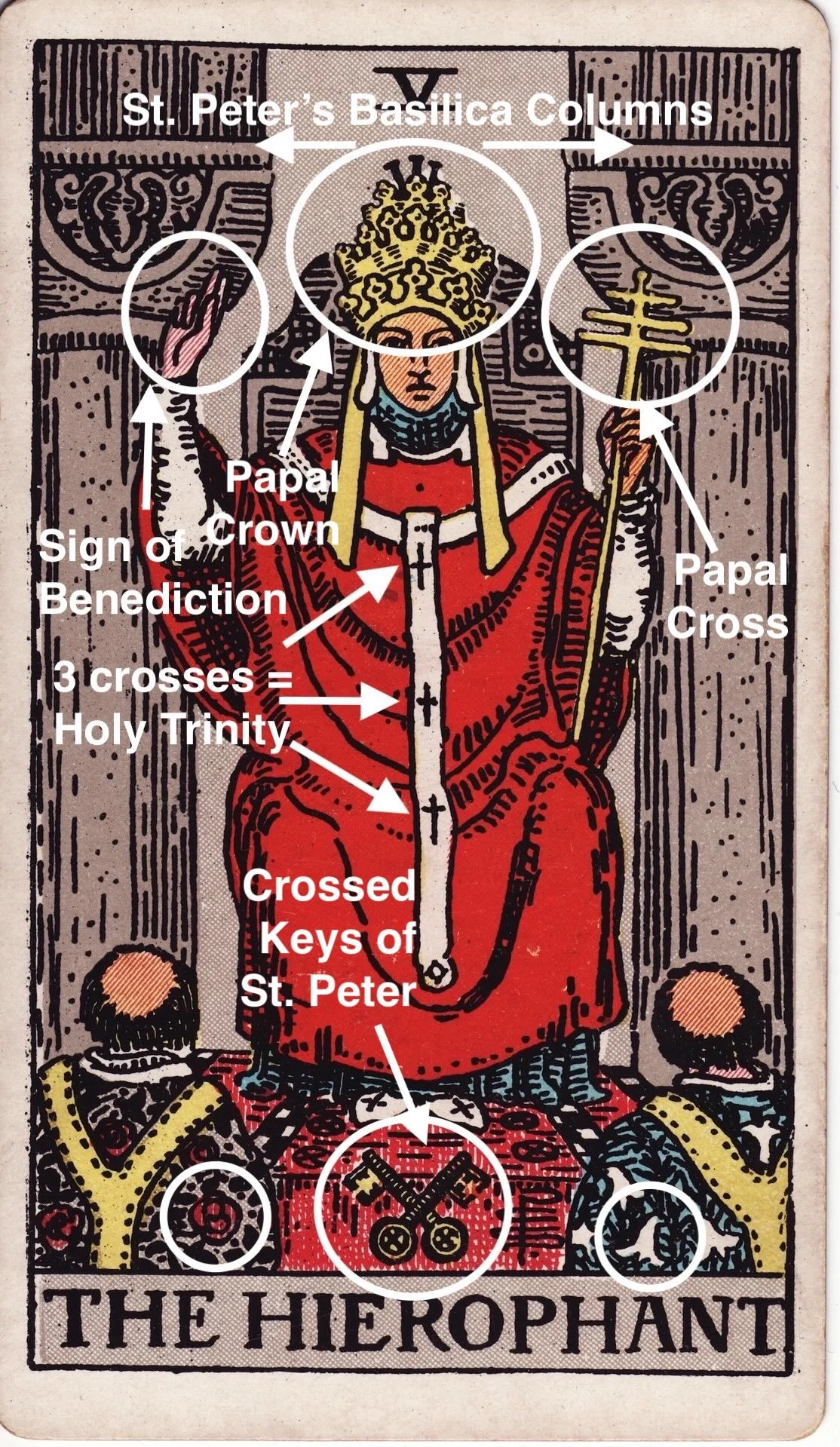
The Hierophant Card, Pamela Colman Smith, 1909.
"is the channel of grace belonging to the world of institution as distinct from that of Nature, and he is the leader of salvation for the human race at large. He is the order and the head of the recognized hierarchy, which is the reflection of another and greater hierarchic order…and he is not religion, although he is a mode of its expression." (Emphasis is mine.)
This suggests that the Hierophant extends beyond any temporal role and alludes to the archetype of the Sage Teacher who acts as a bridge between divine knowledge and human teachings.
However, what we see in Pamela Colman Smith's illustration is a Pope. Maybe not a specific Pope, but that figure is unreservedly papal.
The triple crown, triple cross scepter, and crossed keys are all traditional regalia and insignia of the papal office. The crossed keys show that he sits on St. Peter's throne, referencing Jesus giving Peter the keys to the Church, and they remain part of the papacy's official emblem. Beyond these specific attributes, three small black crosses appear on his robe, and three figures appear in the scene. Anything in triplicate when it comes to Catholicism references one thing—the Holy Trinity. And though the concept of triplicity is deeply rooted in many mythologies and religions, its presentation in this image points to one thing—Catholic father of all the fathers.
Even more, the Hierophant stands between two large columns that resemble those in St. Peter's Basilica in the Vatican, where the Pope lives and holds office.
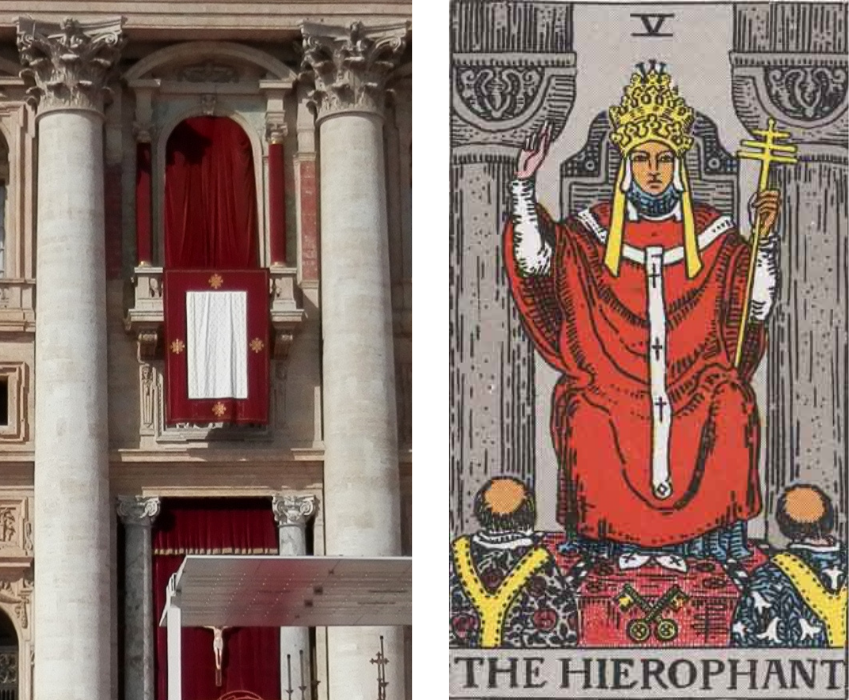
Left: a detail of the Pope’s balcony at St. Peter’s Basilica at the inauguration of Pope Francis in 2013; Right: The Hierophant card by Pamela Colman Smith, 1909.
Down to the sign of benediction he makes with his right hand (more on this coming in a follow-up post), this figure is not a suggestion of a Pope. He is a direct representation of a Pope. This is a puzzling mystery to me, and yet another instance where I find Waite's written description doesn't always match Smith's pictorial representation.
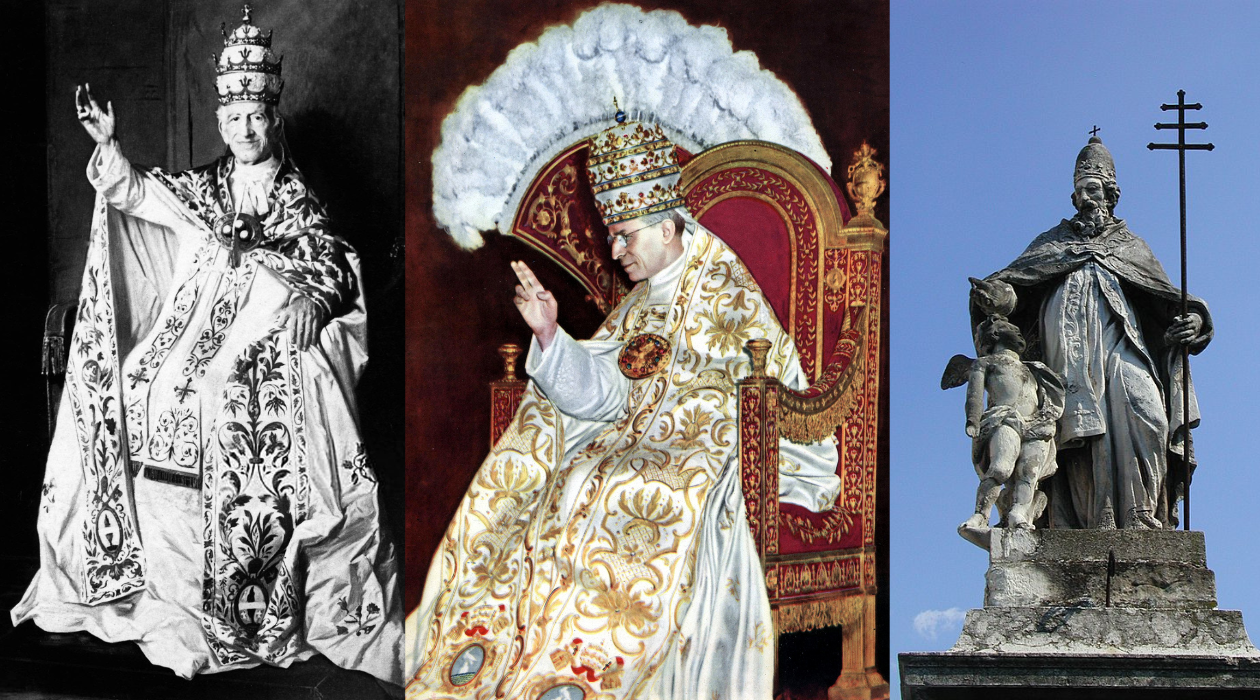
Left: Pope Leo XIII in papal regalia: The triregnum, falda, mantum, and the stole; Center: 1949's color print of Pope Pius XII in the Sedia Gestatoria during a mass to commemorate the 10th anniversary of his papal coronation; Right: Statue of Pope Sylvester I depicted holding a ferula with a papal cross.
Now, Waite and Smith intentionally added Christian iconography to their deck to make the symbolism more recognizable and understandable to early 20th-century readers who weren't initiates into a mystery cult like the Hermetic Order of the Golden Dawn. Even in 1909, after the Catholic Church's influence had declined since the days of Henry VIII and Martin Luther, Catholics still considered the Pope the highest spiritual authority, and other Christians would've recognized that reference. So, to make it easier to decipher, the papal figure makes sense.
What mystifies me is why Smith included so much more in the High Priestess card that touched on the deeper meaning of that archetype, eschewing much of the Tarot de Marseilles' traditional popess imagery, and stayed full-on Catholic here?
In comparing Smith's High Priestess with an 18th-century edition of a Tarot de Marseille deck, I see that, compositionally, she kept elements from La Pance's (Popess) image—a woman seated before a veil, wearing a crown, and holding written word, here in the form of a book. That's it. The details completely change. Smith has her High Priestess wearing blue robes emblazoned with a gold cross and the crown of Isis, sitting between two columns, with water hinted at beyond the veil, decorated with pomegranates and palms, and a crescent moon at her feet. She holds a half-concealed scroll rather than an open book, which is significant in that an open book symbolizes known knowledge. The High Priestess' scroll is half rolled and half hidden behind her robes, suggesting it is only partially known.
Her Hierophant card, on the other hand, is a compositional match and, though much more intricate, the attributes remain mostly the same. Her Hierophant holds a scepter with the papal cross (making her card a bit more papal than La Pape here), and there are two figures in hers and three in Le Pape. But for the most part, the overall details are the same—red-robed personage, standing between two columns, wearing the triple crown with figures kneeling at his feet while he gives the sign of benediction.
The High Priestess card references Mary but also mixes in symbols from Persephone, Isis, and moon goddesses. The Hierophant, on the other hand, only has a low-key link to the Magician through the roses and lilies on the robes of the two kneeling figures. Otherwise, he is shown as completely papal.

Left: Le Pape Tarot De Marseilles Card from the deck of Jean Dodal, 1701-1715; Left-center: The Hierophant by Pamela Colman Smith, 1909; Right-center: La Pances Tarot De Marseilles Card from the deck of Jean Dodal, 1701-1715; Right: The High Priestess by Pamela Colman Smith, 1909.
Meanwhile, Waite's description seems at first to diverge from Smith's art, or does it? What if, by making him a Pope, they moved him from the "mystery" associated with the High Priestess to the "manifest," which at the time would still have been most recognizable to Christians in the Church?
The word 'hierophant' comes from Greek and loosely translates to 'someone who reveals the sacred.' It originally referred to the high priests in the Eleusinian Mysteries. We don't have records of their secret ceremonies, but we do know they were connected to the goddesses Demeter and Persephone. Otherwise, what their hierophants would've looked like remains as big a mystery as the Eleusinian Mysteries themselves
One might expect, then, for the image of a hierophant to show more Greco-Roman symbols with its Greek roots. But in Western European history after the Roman Empire, the Pope was seen for millennia as the highest example of divine knowledge on earth. He truly is the 'order and head of the recognized hierarchy' in the Catholic Church and a 'mode of its expression.'
All of this could explain why tarot readers and authors interpret this card differently. I checked my usual reference books and found the following:
Benebell Wen, who wrote Holistic Tarot (my OG favorite tarot reference), writes:
"The Hierophant card suggests conformity as the prevailing impulse. To conform, one must repress certain aspects of oneself that are different from others'. Hence the Hierophant card is also about concealment. It can represent deception, the concealment or distortion of truths."
As I read her interpretation, I feel she's focused on the thin line between being a spiritual guide and strict hierarchies that can lead to oppression, with hints that institutions (like the Catholic Church) tend to gatekeep information more than they share.
I don't disagree with Wen, but I wonder if the papal symbolism has her viewing the card through a modern lens, given the papacy's difficult history. This includes recent coverups of child abuse, the old practice of selling indulgences to forgive sins, and the many holy wars that have left lasting divisions between Christian, Judaic, and Islamic faiths.
I'm not sure people in the early 1900s were as disillusioned with the Vatican as many are now. Pamela Colman Smith actually left Spiritualism a few years after finishing the deck. She devoted herself to Catholicism, and so maybe she chose strong papal imagery because she personally venerated the Pope as a spiritual teacher and leader.
I think Wen leans heavier toward the shadow side of the card in the whole interpretation. And trust me, I get it. I struggle with how overtly Catholic this card is, since my understanding of the Hierophant as a concept and archetype doesn't line up with my view of the papacy.
For instance, she goes on to write, "The Hierophant represents orthodoxy: conforming to what is the present norm, membership in the majority, and having the approval of those in power." If historically a hierophant was associated with one of the most mysterious mystery cults in history, then the Hierophant wouldn't represent 'membership in the majority.' For the leader of the Catholic Church, though, yes, that's an apt description.
But when the image on the card reflects something specific and that image doesn't fulfill its duty to illustrate the meaning of the text, which way do we go? As much as I lean into the symbolism in the images when I read Tarot, writing this post makes me realize that, with this card in particular, I lean more on the meaning of its title. And I entertain the nuance to Smith's choice, knowing she was working within the confines of her time and that her Hierophant may be a victim of accessible iconography.
Because when it comes to how I view a Hierophant in the archetypal sense, Mariana Louis—whose book Tarot and the Psychology of the Soul has become a new favorite of mine—sums it up beautifully. On this card, her ideas are:
"He guides us into the temple and shows us the words in the book, the colors on the canvas, the stars in the night sky, and communicates what is wholly sacred within them…He will speak this doctrine and facilitate the hierophany: his teaching will act as the bridge by which higher knowledge crosses to become a lived mystery…His power is to disseminate the knowledge he accesses, which when abused, produces hierarchical ladders, dogma, and orthodoxy. Then the Hierophant becomes a version of the Devil, who is in his mocking pose, inverting the sacred back into the profane and inflating the profane to eclipse the sacred."
While Wen's account feels a hair harsh, I agree with Louis that this side appears when power is abused. Wen seems to suggest the card always represents someone already misusing their power. And I see my understanding of what a Hierophant is (not necessarily a Catholic Pope) more in Louis' description.
Especially in the 'becomes a version of the Devil' note. Before I read Louis' passage, I looked through my Pamela Colman Smith deck for cards that connect to the Hierophant in ways beyond his role as the Sage, which balances the Emperor's Warrior/King role, or as the keeper of outer wisdom alongside the High Priestess's inner knowledge.
Since I plan to explore the Hierophant's sign of benediction later, I started looking at the gestures in the other cards and noticed the Devil card. I usually connect the Devil with the Lovers, but here I saw that the Devil also raises his right hand (though it looks more like the Vulcan sign than anything else to me). The Hierophant holds his triple-crossed scepter in his left hand, while the Devil holds a firelit torch pointing down, almost as if he just set the tail on the male figure (often seen as Adam from the Old Testament) on fire.
When reading symbols, whether in medieval and Renaissance art or in divination, direction of action matters. For example, the Magician's raised right arm with a wand and left hand pointing down shows he can channel energy from above to the earth. The Hierophant's raised hand and scepter also suggest receiving wisdom and power from above and creating a bridge between the two, emphasizing his role as a bridge between the divine and the earthly. In contrast, the Devil's alteration then becomes a symbol of misdirected or shadow authority.
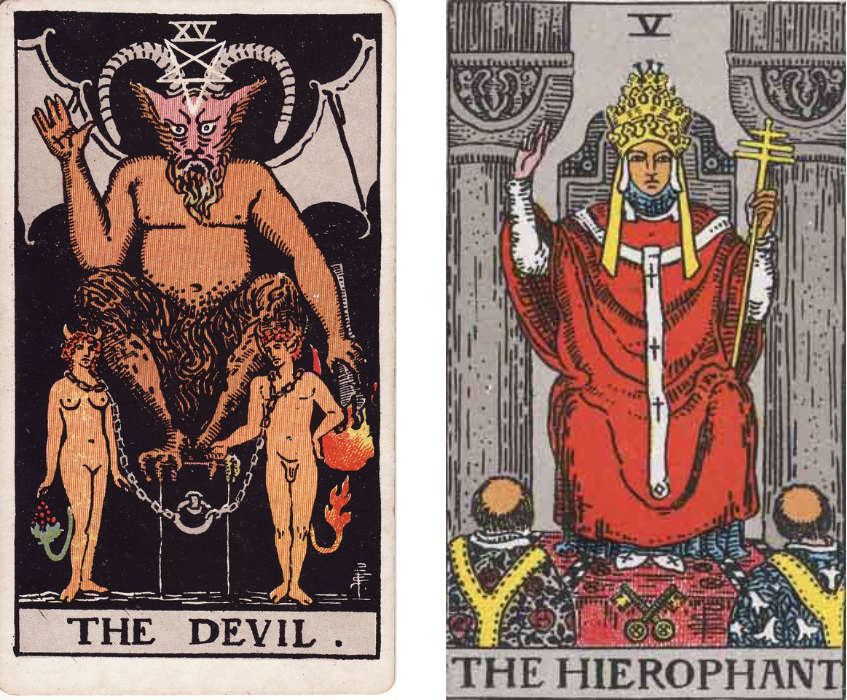
Left: The Devil; Right: The Hierophant by Pamela Colman Smith, 1909.
And I find it interesting that Waite makes specific mention of the Hierophant's sign and that the High Priestess does not make one. So while those two are linked through their masculine-feminine roles as knowers of all things, her lack of a sign makes his presence even more significant.
Ultimately, I see the Hierophant as a complex bridge between the silent, esoteric mysteries of the High Priestess and the structured, external understanding of those mysteries. While the overtly papal iconography of the triple crown and crossed keys could be seen as representing institutional orthodoxy, the title itself reminds us of its ancient roots in the Eleusinian Mysteries. That role is defined by revealing the sacred rather than gatekeeping it, though an abuse of power could easily lead this way. He is the Sage who translates divine wisdom into human language, mediating a sort of "papal" union between the seeker and the spirit. Yet, perhaps the most telling detail of this mediation lies not in his regalia, but in his movement. Waite pointedly noting that the High Priestess remains still and makes no sign, while the Hierophant actively raises his hand in a well-known ecclesiastical sign is quite telling. This distinction marks the transition from wisdom that is simply held to wisdom that is bestowed, leading us directly into the layered history and hidden meanings of the sign of benediction—a gesture that links the Hierophant to both the divine authority of Christ Pantocrator and the shadow-mirroring of the Devil.
And though most of my decks carry on this papal imagery in some way, and it isn’t my favorite way to picture the Hierophant, I do have two decks I think got closer to nailing the archetype’s energy.
References & Recommended Reading:
Chang, Susan T., and Meleen M. M. Tarot Deciphered: Decoding Esoteric Symbolism in Modern Tarot. MN: Llewellyn Publications, 2021.
Ferguson, George. Signs & symbols in Christian art. London: Oxford University Press, 1989.
Kaplan, Stuart R., Mary Katherine Greer, Elizabeth Foley O’Connor, and Melinda Boyd Parsons. Pamela Colman Smith: The untold story. Stamford, CT: U.S. Games Systems, Inc., 2018.
Louis, Mariana. Tarot and the Psychology of the Soul: Exploring the Archetypal Mirrors of the Psyche. Weiser Books, 2026.
O’Connor, Elizabeth Foley. Pamela Colman Smith: Artist, Feminist, and Mystic. SC: Clemson University Press, 2024.
Nozedar, Adele. The element encyclopedia of secret signs and symbols: The ultimate A-Z guide from Alchemy to the zodiac. London, UK: HarperElement, 2008.
Waite, A.E. The Pictorial Key to the Tarot: Pamela Colman Smith commemorative set by Stuart Kaplan. Stamford, CT: U S Games Systems, 2009.
Wen, Benebell. Holistic Tarot: An Integrative Approach to Using Tarot for Personal Growth. CA: North Atlantic Books, 2015.
Image Credits:
Photo of Pope Leo XIII via the Public Domain.
Photo of Pope Pius XII in crown giving blessing sign caption via the Public Domain.
Statue of Pope Sylvester I depicted holding a ferula with a papal cross via the Public Domain.
Tarot cards from the deck of Jean Dodal of en: Lyon, a classic Tarot of Marseilles deck which dates from 1701-1715 via the Public Domain.
Pamela Colman Smith tarot cards via the Public Domain.


